
Where Code Meets Capital
CHRIS QUIRK
In the finance industry, success or failure, profit or loss can hinge on exceedingly fine margins. A fraction of a percentage point or a fraction of a second can be decisive, and the often zero-sum competition drives market players to exploit every advantage available.
This search for a competitive advantage makes the field of finance ripe for automated tools and the edge advanced algorithms can bestow. Finance companies and fund managers have been using machine learning tools since at least the 1980s. Credit companies employ machine learning to nip fraud in the bud. And high-frequency trading — a controversial but prevalent form of investing that depends on massive numbers of low-return trades — depends on algorithmic tools.
As artificial intelligence becomes more sophisticated, many experts in the finance industry have been eager to put it to work to handle increasingly heavy data workloads, find hidden trends and seek useful information.
Robert Simon, executive director of the Master of Science in Computational Finance program — a joint initiative of the Tepper School of Business, Mellon College of Science, Dietrich College of Humanities and Social Sciences and the School of Computer Science — contends that the finance industry faces an unmet demand for professionals with computer science training.
“For the last three years, our graduation-plus-three-months placement rate has been about 99%,” he said. “The field is very attractive to many computer science students. In Silicon Valley, you can work on a startup for a decade before it launches. In finance, you can try something, and you can see if it works in a matter of seconds. That can be very rewarding if that’s the way you’re wired.”

Robert Simon, executive director of the Master of Science in Computational Finance program
Melissa Goldman (SCS 1992), partner and global head of engineering for global banking and markets at Goldman Sachs, has worked in finance for her entire professional career. She currently leads the engineering organization responsible for the platforms, systems and products that support Goldman Sachs’ markets and banking businesses around the world. Goldman says the finance field presents admirable challenges for enterprising computer scientists and a dynamic career opportunity.
“From a computer science perspective, finance is one of the most technically demanding environments: high reliability distributed systems, cybersecurity, data engineering at scale, and increasingly complex cloud and platform engineering, all under rigorous governance and regulatory expectations,” Goldman said. “The pace of change is also unusually fast, and the feedback loop is immediate. You can often see the impact of engineering improvements quickly in production, in client experiences and in how the business performs in real market conditions.”

Melissa Goldman (SCS 1992), partner and global head of engineering for global banking and markets at Goldman Sachs
For anyone with computer science expertise and a taste for these kinds of challenges, Hilary Packer (SCS 1994), executive vice president and chief technology officer at American Express, has some good news — you’ve already done the hard part.
“When I was coming out of CMU, I remember talking to people and saying, ‘I think I’m going to take this job at this financial services company.’ I was little worried because I wasn’t even sure I knew how to balance my checkbook,” she said. “But I always tell people when we’re interviewing candidates at any level, that if you’ve learned computer science, I can teach you what you need to know about the financial services industry. It’s much harder if you come in with all this financial services experience but have never studied anything related to technology, and I have to teach you that part on the job.”

Hilary Packer (SCS 1994), Executive VP
and CTO at American Express
While companies are exploiting the speed and power of AI, they are, as a result, also creating much larger data flows for their infrastructure to manage, and much more information that must be speedily analyzed to pick out the actionable gems. Computer scientists work continuously behind the scenes to build and increase the capacity of these systems to keep up with the expanding volume of information.
“As mature as the finance industry is, there are huge levels of innovation and really transformative things that are going on right now, and it’s evolving at a quicker pace,” said Simon.
One example is cash equity trading, where companies use their own funds to buy stocks or other assets. It’s an area where players often look for intelligence about what other major players are up to.
“There’s been a lot of automation there, and some very advanced developments. If you think about trying to go and suss out what somebody else is doing and then trying to trade ahead or around those transactions, it’s probably the most complex game theory model in the world,” said Simon. “You have all these actors out there, and you’re theoretically blind to all of them. But if you can look at the tea leaves and see that somebody’s up to something, you can go and react and trade around that. That’s what the high frequency trading and professional trading firms are doing — and it’s at the far end of sophistication.”
Financial companies use agentic AI heavily because of its ability to perform demanding analysis and review processes at lightning speeds. At American Express, Packer implemented a system that streamlines complex marketing and compliance resolutions. When creating campaigns, marketers follow established legal and compliance guidelines.
“It’s a great use case for AI. The marketers come up with an idea for a campaign, and they send it over to marketing compliance to ensure that the elements of the campaign are in keeping with the guidelines. They analyze the campaign with AI, which identifies any gaps or things that have to be addressed, and it shows how we can have a dialogue between marketing and compliance to resolve the issues,” she said.
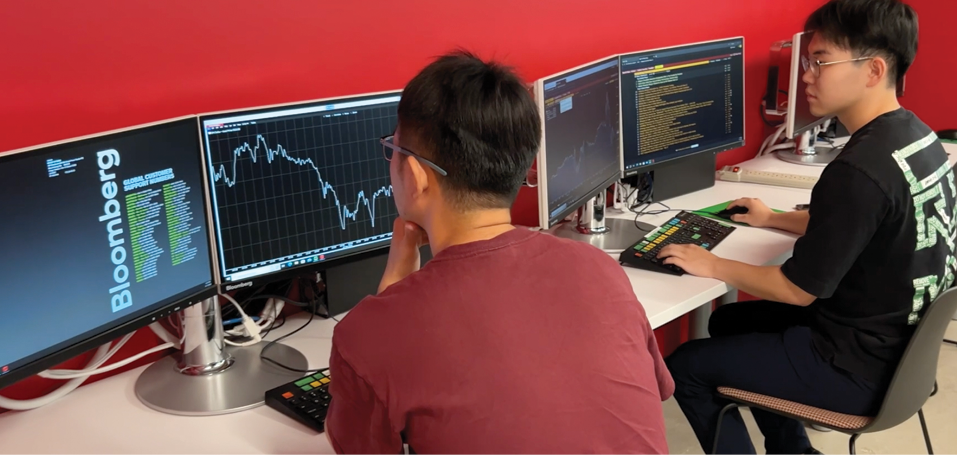
Students backtest portfolios ahead of their Build Your Own Hedge Fund presentations.
Packer also emphasized how critical human oversight is when employing AI. “That’s really important to us. It’s part of our responsibility. AI is not perfect. It’s not 100% accurate all the time, so we have to ensure we have appropriate human oversight throughout the process. We’re doing this work to enhance the capabilities of our colleagues and to allow them more capacity to work on other interesting or higher value aspects of things while we’re automating areas where you don’t need a person to execute. But we’re not looking to replace human judgment. We’re improving quality and efficiency, and helping our teams move faster.”
Due to the unique legal and fiduciary requirements in the finance sector, many functions in the field won’t cross the rubicon of full autonomy until the “black box” problem — the inability of humans to audit how an algorithm reaches a decision — is resolved. Policymakers are currently debating AI accountability for products like mortgage lending, where fairness dictates if a prospective borrower is turned down, and they have a right to know why. In addition, the European Union’s AI Act, which took effect in 2024, mandates transparency for companies that use AI tools.
“In a large financial services firm, the challenge is often less about building a model or agent and more about proving you can deploy it safely, reliably and repeatedly in a highly regulated environment,” said Goldman. “Auditability and explainability are essential, and transitioning to more nondeterministic systems requires the right control framework to manage risk.”
Simon agrees with the need for human oversight, describing a potentially perilous scenario.
“Say you are somebody that crashed a market. Maybe a client comes in that’s over-leveraged or something goes wrong. And let’s further say that this event is very front-facing,” he said. “In a matter of minutes — not days, not hours, minutes — regulators will come in and address you. And if you just shrug and say, ‘Well, I don’t know; it’s fully autonomous. I don’t have the controls in place. I don’t understand what’s under the hood because it’s been self-evolving for the last two years,’ that is not going to be an acceptable answer.”
The finance industry currently needs computer science expertise, according to a recent study by the Linux Foundation. In their report, “The State of Tech Talent,” they found that the financial operations sector — which combines IT, finance and business to manage cost and implement efficiencies — is 61% understaffed.
How Finance Companies Use AI
Machine learning has long been employed by finance companies to enhance operations. As artificial intelligence advances, here are some of the ways companies take advantage of the technology:
Algorithmic trading: Traders use AI tools to quickly research and react to opportunities in markets.
Automate workflows: AI and machine learning tools speed the processing of massive quantities of transactions and internal workflows.
Credit scoring/mortgage evaluation: Automated tools instantaneously assess creditworthiness.
Fraud detection: Algorithms analyze credit use patterns and locations to detect anomalies in real time.
Portfolio management: Advisers use AI tools to manage assets to meet defined goals.
Regulatory review: Compliance agents employ AI and AI agents to meet legal requirements and flag suspicious patterns and transactions.
Predictive/forecasting: Brokers track market movements using algorithms to uncover trading opportunities.
Jeff Wecker, chief technology officer and head of engineering at Two Sigma, a data-driven investment firm that employs AI extensively, looks to SCS when he seeks top talent. “Even before I arrived, Two Sigma had a strong history of recruiting computer scientists and other CMU graduates,” he said. “My unique vantage point — working closely with these individuals while also understanding how the program operates — has only reinforced that practice. As we’ve scaled, the CMU contingent within Two Sigma has scaled right alongside our growth.”
Wecker said the rigor and challenges of the CMU program prepare students exceptionally well for their careers.

Jeff Wecker, chief technology officer and head of engineering at Two Sigma
“It makes them ready for anything, and you see the benefits of this in whatever path they choose to pursue. My impressions of SCS have been shaped by decades of experience hiring and working with its graduates, watching my daughter earn her degree there, and serving on the Dean’s Advisory Board. All of these perspectives point to the same conclusion: SCS is one of the finest institutions in the world for preparing students and delivering vital, relevant research in computer science.”
Simon reported that finance companies are looking for people with talents beyond the technical, given the many services companies deliver.
“I see firms looking for people who have technical skills, but more fundamentally, people who are thoughtful, creative problem solvers. Whether you’re solving them with Python or C++, vibe coding assistance is somewhat irrelevant,” he said. “You can’t be successful in the future just from a productivity standpoint without using those tools, but they need to augment the other skills.”
Packer emphasized that there are many different aspects of the financial services world, with broad opportunities and engaging challenges for computer scientists.
“We have an incredibly rich history of using AI in finance. You think about a company like American Express; we’ve been using classical AI for 15 years now in areas like fraud prevention and credit risk decisioning. We still use them, and they rely on classical machine learning models. I spent 20 years building equities trading systems and now do something completely different in financial services, focused on the payments end,” she said. “I ended up in financial services largely because when I was at CMU, I did on-campus interviewing through the Career and Professional Development Center. The problems that they were solving seemed really interesting, the kind of people that I was meeting through the process were incredibly smart, and it seemed like it was going to be a lot of fun. And it has been. What more do you want out of a job?” ■
More from the Fall 2026 LINK Issue

Building at the Speed of AI