Guarding the Future
A CMU Robotics Team Is BuiIding the Next Generation of Security Robots
SHERI HALL
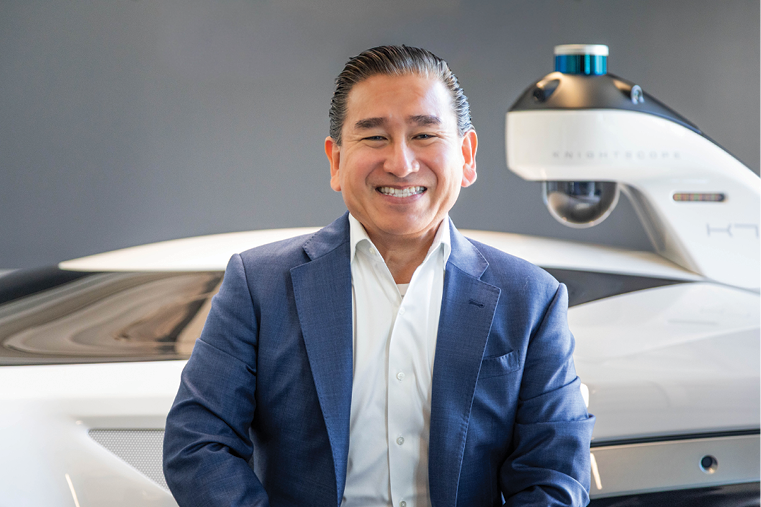
When William Santana Li (ENG 1991) graduated from Carnegie Mellon — a year early, with a bachelor’s degree in electrical engineering and a minor in mechanical engineering — he never imagined that he would return three decades later to establish a partnership supporting one
of the most important undertakings of his career.
Li is the founder, chairman and CEO of Knightscope Inc., a Silicon Valley company offering security services using proprietary autonomous robots.
He returned to CMU with a mission: to formalize a long-term research relationship to help address what he believes is a national crisis. “The first role of government is to protect its citizens,” Li said. “And right now, our nation’s security infrastructure is failing.”
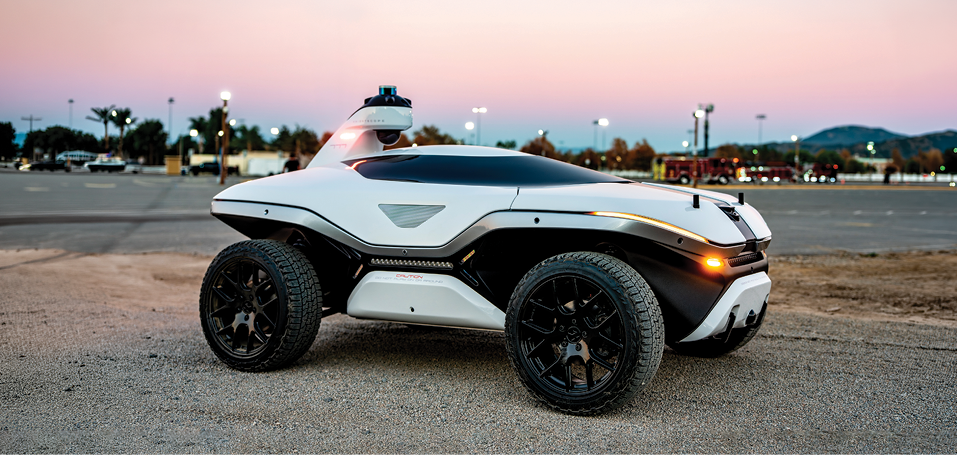
Founded in 2013, Knightscope combines autonomous robots, AI-powered software and human operators to manage security for retail centers, hospitals, hotels, manufacturing facilities and college campuses throughout the country. The company uses a robot called the K5, which is designed for outdoor patrolling at up to 3 miles per hour.
To push this technology forward, Knightscope has entered a five-year agreement with CMU’s Master of Science in Robotic Systems Development (MRSD) program, which equips its students to work in the robotics industry.
The partnership centers around a capstone project, where graduate students help to build a next-generation patrolling robot. Li is also interested in creating a National Security Robotics Lab to drive advanced research at the intersection of robotics, autonomy and public safety.
“The talent that comes out of CMU is the top of the field,” Li said. “I wanted to formalize a relationship and establish a lab here at Knightscope headquarters in the heart of Silicon Valley — not just sponsor a one-off project, but commit to something ongoing.”
“The talent that comes out of CMU is the top of the field.”
— William Santana Li, Founder, Chairman and CEO of Knightscope Inc.
A Five-Year Bet on Students
The seeds of this partnership were planted when MRSD Director John Dolan sent out his annual outreach email, asking industry leaders to propose capstone projects for his robotics graduate students.
For Dolan — a retired Army colonel with four years of active duty, a military intelligence background and nearly three decades in the reserves — the project interests him both professionally and personally.
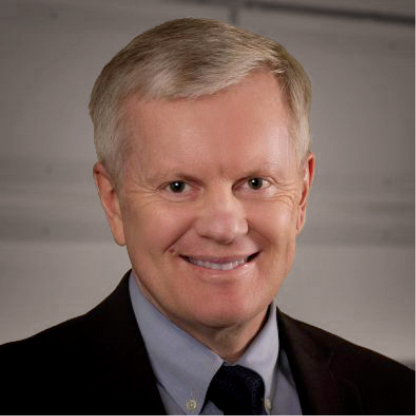
John Dolan, MRSD Director
Under the current structure, Knightscope supports a team of students working on the all-new K7 Autonomous Security Robot (ASR), a four-wheel robot designed to patrol outdoors at up to 10 miles per hour.
The five-person team from CMU — which includes students with backgrounds in computer science, mechanical engineering and electrical engineering — started the project in September 2025. During the fall, they focused entirely on planning — including project management, risk analysis and scheduling.

The MRSD Knightscope Team (left to right): Hongyi (Sam) Dong, Tzu-Cheng (Joshua) Tsai, Pin-Wen Wang, Chenxi (Leo) Xu and Po-Ting Ko.
In January 2026, the team began building their first prototype — a small, remotely controlled indoor vehicle used to familiarize the team with the software and the basics of building an autonomous vehicle from scratch.
Hongyi (Sam) Dong, an MRSD student on the Knightscope team, explained that this part of the project was all about student learning. “We weren’t trying to build something impressive,” he said. “We were trying to understand.”
In March, the team began work on a second, larger prototype that introduced enhanced autonomy, simulation testing and a more robust user interface.
By the end of the spring semester, the team had developed a working simulation of the full system. They plan to deploy the system on physical hardware in fall of 2026. If all goes well, they will then transfer the software to an actual K7 prototype housed at Knightscope’s headquarters.
“We’re producing something genuinely useful for the company. That makes a difference in how you approach the work.”
— Hongyi (Sam) Dong, Master’s Student in the MRSD program
Real World Opportunity for Students
For the students, the Knightscope project offers something that few academic programs can replicate: the pressure and accountability of working on a real product with a real client. “We’re producing something genuinely useful for the company,” Dong said. “That makes a difference in how you approach the work.”
Finding a capstone partner that wants to use student work in commercial production is unique, Dolan explained. “William doesn’t want it to be simply a school science project,” he said. “He wants students to go through an actual product development process. He is really committed to integrating the students as much as possible, which is extraordinary.”
To make that happen, the company set aside a dedicated space for the CMU team in its California facility. The students have made two trips there, including spending their entire spring break working alongside Knightscope’s autonomy engineers.
And they had the opportunity to present a live demonstration of their interface to Li and the company’s program manager — a learning experience that you can’t find in a typical classroom. Afterward, Li spent several hours with the students talking about technology, careers, robots and AI.
Not a Robot Company — A Security Company
Li grew up in New York City, the son of parents who emigrated from Colombia and China. The September 11 terrorist attacks struck close to home. “Someone hit my town, and I’m still angry about it,” he said. “Since then, I’ve dedicated myself to securing this country.”
His goal was not to build a robotics company, but a security company. Knightscope doesn’t offer a product. It offers a managed service — hardware, software and humans operating together — that customers can commission.
The company’s orchestration software platform, called Signals, works via an escalation model: autonomous patrolling robots conduct surveillance and flag important events to remote human operators, who then alert personnel on the ground to potential threats. The system is designed to place people in decision-making roles rather than flood them with data they can’t process.
“You can have a million cameras, and you’re still blind,” Li said. “Fifty screens on a wall — a human can’t monitor all that. Technology alone is a recipe for failure. But if you use technology to support humans in making decisions, and to avoid boring work, maybe we’ll get somewhere.”
Li has been vocal in Washington D.C., about establishing a national robotics strategy. He hopes the CMU partnership will become part of a larger effort to ensure that the United States remains competitive in autonomous systems. “We are at high risk of losing the robotics race,” he said. “We need the private sector, government and academia to work together to build the infrastructure this country sorely needs.”
From Dolan’s perspective, the partnership offers a sustainable bridge between research and the demands of industry.
“The financial benefit is real,” said Dolan. “But more than that, sponsors who are committed — really committed, the way William is — give students something that money can’t buy: the experience of doing work that matters, with people who are counting on them.”
If the team is successful, software built by five graduate students in Pittsburgh could one day guide a security robot along the perimeter of a facility somewhere in the United States.
For Li, that outcome would be exactly what he came back to CMU to find. “I wanted real work,” he said. “Real engineers. Real exchange. I think that’s what we have. ■
More from the Fall 2026 LINK Issue
Where Code Meets Capital