
Advancing Medical Advocacy
and Access to Resources in Healthcare
AMY WHIPPLE
On Flora’s first day working at Pair Team in fall 2025, she fielded a call from a 67-year-old woman. The woman had post-traumatic stress disorder, congestive heart failure and was living in her car. She and Flora talked for an hour about those challenges.
“It was both the most exciting and sobering thing,” said Neil Batlivala (SCS 2014), co-founder and CEO of Pair Team, an AI-enabled healthcare company that connects Medicare and Medicaid patients with comprehensive whole-person care. “The technology is here, and this woman did not have anyone else to really talk to for that long.”
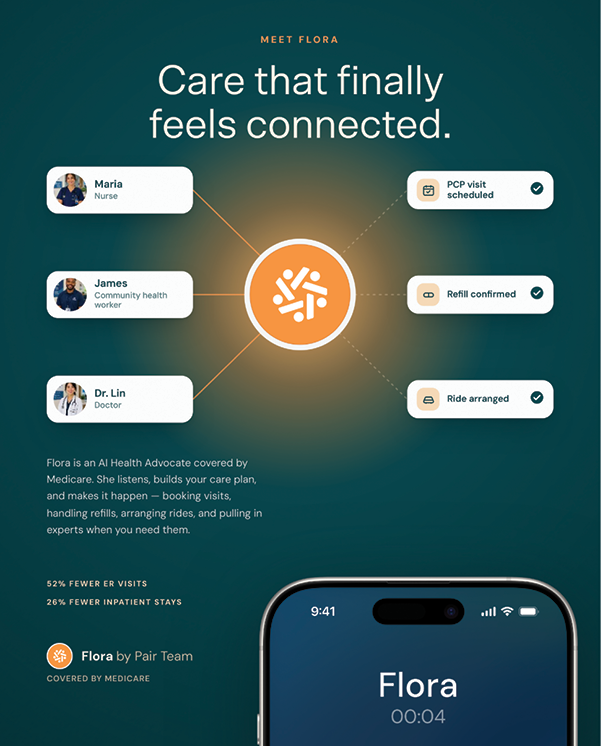
The technology: Flora, Pair Team’s first AI agent, capable of having lengthy conversations with the Pair Team’s almost 30,000 high-needs patients.
These days, Flora is the first voice a patient hears at Pair Team. That initial conversation, however, is only the beginning.
“We have many instances now where people call after hours, and they stay on the phone for 30 minutes, 45 minutes, an hour talking to Flora, really diving into their life,” said Batlivala.
In a traditional healthcare model, care managers aren’t afforded the opportunity to connect with patients on that level.
As part of care management, Flora recognizes people’s patterns. “You need to go to an appointment,” Flora might say. “I know your daughter usually drives you. Let me text her just to make sure.” Flora can
also discern from a picture of a meal or a menu if a person is meeting their dietary needs.
“Those are very different ways to engage with the system,” Batlivala said.
The seeds of Pair Team formed in Batlivala’s childhood in India and Singapore. “That’s a lot of my ‘why,’” he said. “I grew up with a mom who instilled in me a sense of duty to support others.”
When he arrived at CMU to study computational biology, Batlivala assumed he would eventually practice medicine. “Instead, I fell in love with technology toward the same mission,” he said.

Neil Batlivala (SCS 2014), Co-founder and CEO of Pair Team
Batlivala founded Pair Team in 2019 to address healthcare in the traditional clinical sense, in concert with social issues such as inadequate housing and food that hinder people’s ability to fully benefit from clinical care.
He holds fast to the belief that everyone should have access to universal, high-quality medical care. “But how do you scale that access for 10 billion people?” he asked. “How do you scale the best nurse you’ve ever worked with, the best doctor you’ve ever worked with, the best care manager and care coordinator that you’ve ever worked with?”
According to the Centers for Disease Control and Prevention, the United States amasses $4.9 trillion in annual healthcare expenditures. People with chronic physical and mental health conditions account for 90% of that spending. In addition to health benefits, interventions for prevention and management of those conditions also offer economic benefits.
For instance, Pair Team’s efforts to reduce social roadblocks have translated into reducing emergency room visits by 52% and inpatient hospitalization by 26%. “We save the system money,” Batlivala said, “and that’s how we are making it sustainable.”

The Ethics of AI in Healthcare
Batlivala is not the only SCS alumnus harnessing the power of AI to advocate for better healthcare access and resources. Ranging from active platforms like Pair Team to early research, alumni, students and faculty are exploring possibilities to support marginalized and at-risk populations. While doing so, they also face the limitation of AI in the complex medical and social systems that surround those communities.
“We are in the middle of this new AI world order,” said Batlivala. “How do you drive that AI adoption and increase access to care for those that really need it?”
In a time of exponential AI advances, the American Medical Association suggests four core values for incorporating AI into existing systems. Technologies, it says, should: 1) enhance patient care,
2) improve population health, 3) improve the work life of healthcare providers and 4) reduce costs.
The World Health Organization (WHO) has also issued guidance on the ethics of large language models in healthcare. Among other considerations, the organization believes AI-based technologies should ensure inclusiveness and equity, from initial coding to market availability.

Jodi Forlizzi, Herbert A. Simon Professor of Human-Computer Interaction and Computer Science
People who are poor, less educated or in underrepresented groups do not have equal access to AI,” said Jodi Forlizzi, Herbert A. Simon Professor of Human-Computer Interaction and Computer Science, “and the models for those groups have more bias. So that’s a major concern.”
WHO also calls for responsibility and accountability by users and the importance of quality control by developers.
“I think the core thing to remember is that this technology is a tool, like many others that we’ve seen historically, and we still need human judgment in its development and use,” said Forlizzi.
Toward that end, students, alumni and researchers in SCS have developed PeerCoPilot, an AI tool that assists mental health providers in creating wellness plans and resource recommendations. The tool pulls information from vetted sources only in an effort to reduce errors common to LLMs.
Batlivala said that Pair Team are continuing to collect information specific to each community they serve. Flora’s database, for instance, contains availability parameters for various shelters such as gender, children or sobriety requirements.
That flow of information works two ways. Pair Team partners with more than 150 community-based organizations that will connect people to the program. Batlivala said Floracan start the intake process within 20 minutes of receiving a referral.
“These are all needs of the moment,” said Batlivala. Waiting too long to meet those needs often makes things worse. “The tricky part with barriers is if you just knocked one down, you immediately hit the next. If you really want to put someone on an upward life trajectory, you have to knock all the barriers down.”
Older Adults’ Invisible Networks
One at-risk population grows larger every year.
According to a 2022 article in the Delaware Journal of Public Health, the United States is expected to have 80 million people over 65 by 2030. In that group, 85% have chronic health conditions such as arthritis, cancer and cardiovascular disease and disproportionately account for approximately 37% of healthcare spending as estimated by the Centers for Medicare and Medicaid Services in 2020.

For Forlizzi, insights into the daily struggles for these older adults came early.
“When I was very young, I encountered an older person who was literally bent like an L. She would stand at the bus stop and yell for someone to help her see when the bus was coming,” she said.
The two developed a friendship as Forlizzi began waiting with the woman to make sure she caught her bus.
“That theme sort of continued on in my work as technology has evolved,” she said.
In between earning a master’s degree in interaction design and a Ph.D. in design in human-computer interaction, Forlizzi was the first designer hired in SCS’s Human-Computer Interaction Institute (HCII) and School of Design in 2001.
“The work that we do in the HCII is collaborative and multidisciplinary. We’re very interested in the application of our research in society,” she said.
As part of the AI Institute for Collaborative Assistance and Responsive Interaction for Networked Groups (AI-CARING) — a National Artificial Intelligence Research Institute funded by the National Science Foundation — Forlizzi and her team are currently investigating caregiving for older adults of lower socioeconomic status who don’t have money to hire a formal caregiver.
“One of the things we found is that there’s a lot of selective caregiving,” Forlizzi said. “People will lie to their adult children to make themselves seem like they’re better off than they are, so they can continue to live independently.”
Rather than initiating requests for assistance, these older adults engage in ad hoc coordination, or what Forlizzi called “piggybacking.” They selectively ask others around them who are already going out,
such as to the pharmacy or church, for small favors like picking up a prescription or to ride along.
“This is very different than saying, ‘I’d like to go to church. Can you take me?’” said Reid Simmons, a research professor in the Robotics Institute who also participates in multiple projects with AI-CARING.
These requests often rely on chance encounters, said Simmons. “A lot of times, there are piggybacking opportunities that fall through the cracks because people just don’t know about them.”

Reid Simmons, Research Professor in the Robotics Institute
For example, there might be 40 people residing in an independent living community, all of whom have varying degrees of personal need and ability to meet the needs of others. “How do you know when people are going to the grocery store?” Simmons asked. “If you had AI agents that could understand what different people’s schedules are and different people’s needs are, then you can try to mix and match them to facilitate this type of piggybacking.”
A prototype for such an agent is still at a distance, said Forlizzi. “The first part is to see if it can work.” Forlizzi’s team takes patterns of data collected from people, including their phones, calendars and GPS locomotion, “to see if we can even train an algorithm to do this reliably.”
If successful, Forlizzi said, the next step would be to determine how that algorithm would appear in a practical sense. She pointed out that design becomes emergent, based on the sometimes-conflicting needs of stakeholders once a technology goes from an idea to human practice. Each stage of development requires evaluating what works for users and what doesn’t, and refining the product as needed. “We don’t always know what we’re going to end up with when we start. We do a lot of reframing.”
Of course, there is also the element of people’s willingness to use or try unfamiliar resources. Reframing can be really critical in helping people accept technology,” she said.
Moving at Their Own Pace
To address potential friction in accepting new technologies, Simmons said, “we are interested in understanding what types of technologies are useful for older adults and how likely they are to adopt the technologies and use them.”
A 2025 survey by AARP found that six in 10 adults over the age of 50 use at least one smart device in their home.
In addition to services like telemedicine, 71% of those surveyed also used health-tracking apps and 59% took digital fitness classes.


For Simmons, one potential technology to add involves taking a personalized approach to training. “Just maintaining physical activity is a big indicator of people being able to live independently,” he said.
Even people who reside in an independent living community might stay in their rooms for fear of falls or worry about getting lost, Simmons said. “Their muscles start atrophying and, from there, it’s a downward spiral.” Functional exercise helps reduce falls, chronic joint pain and cognitive decline, among other benefits. “We’re not talking about building athletes. It’s just getting out and getting moving in a structured way so they can do it on a regular basis.”
While workout mirrors have been part of the home fitness market since 2018, Simmons said, “They’re geared toward athletes, not older adults. They don’t have to bench press 100 pounds to get a good workout.” The mirrors also only offer personalized feedback on form and don’t incorporate feedback on style.
In trying to design an exercise coach, Simmons and his team talked with physical therapists about their approaches for giving feedback. From this, they dialed into a firmer approach versus a more encouraging one. The coach then watched older adults as they exercised and offered feedback based on the person’s preferences. “You’re doing great,” an encouraging coach might say, or a firmer coach might say, “You’ve got two more reps to do. You can push through that.”
Simmons said, however, that performance and verbalized preference are not necessarily correlated. Just because someone performed better with a firmer approach did not mean that they emotionally preferred it. Since the underlying idea was to keep people coming back to exercising, Simmons said, the coach morphed into an exercise buddy.
“We’re making use of the conversational abilities of large language models to interact with people on a more social basis by engaging them in conversation,” he said. The buddy concept can also account for how a person’s preferences might change over the duration of a session or when they otherwise reach a point of pain or fatigue.
Simmons also learned that many older adults go to gyms or fitness classes primarily for the social interaction. “If they’re living in an assisted living facility or independent living facility, they’ll go down to the exercise room at times when they know other people are going to be there,” he said.
This insight could be included in piggybacking. For example, Simmons said, the AI platform might say, “Doris is going down to the gym in an hour to exercise. Do you want to go along with her?”
Building What Comes Next
The need for more healthcare resources of all kinds — as well as assistance in coordinating and managing them — will grow alongside Baby Boomers as they age.
The authors of a paper in the Delaware Journal of Public Health found that, while an overwhelming majority of adults want to age in place, a lack of assistance when it comes to care coordination and patient advocacy can make doing so “fraught with challenges, if not outright dangerous.”
Baba Health seeks to bridge the gap between clinical care and older adults being able to safely remain at home. The platform connects older adults and their families with advocates who assist with appointments, medications and insurance, among other needs.
Audrey Hasson (SCS 2026) joined Baba Health as an engineer. “I knew that I wanted to be a part of a mission that felt human and necessary,” she wrote in a LinkedIn post. In addition to human advocates, Baba has a phone- and text-based AI agent that encourages daily engagement, offers reminders and can notice early signals of barrier to care.
Batlivala said that even connection itself is an access consideration at Pair Team. “It’s important for me that we don’t have an app. It’s all text- or phone-based because those are the most universally accessible methods of communication.”
While Pair Team’s supports have always been covered by Medicare and Medicaid under their status as a medical group, that still didn’t include everyone who could benefit from their organization.
In July, the Centers for Medicare and Medicaid Services launched Advancing Chronic Care With Effective, Scalable Solutions (ACCESS), with Pair Team as one of its initial 150 participants. The 10-year pilot program will test a new payment model that prioritizes a patient’s health outcomes instead of the traditional time spent with a human clinician.
The model removes Medicare payment barriers to technology-supported care services for people who are managing chronic health conditions — or trying to prevent them in the first place — such as high blood pressure, diabetes and depression.
Batlivala recognizes that Flora and other AI agents are not — and cannot be — the only investments we make in healthcare services. He asked, “How do we get more home- and community-based jobs to get people caring for our growing elderly population, while also equipping them with the smartest care manager they’ve ever worked with?”
He has started to investigate the answer to that question. By the end of 2026, Pair Team will have 1,000 employees, which Batlivala said will make the company one of the largest community health workforces in California. ■
More from the Fall 2026 LINK Issue

Building at the Speed of AI