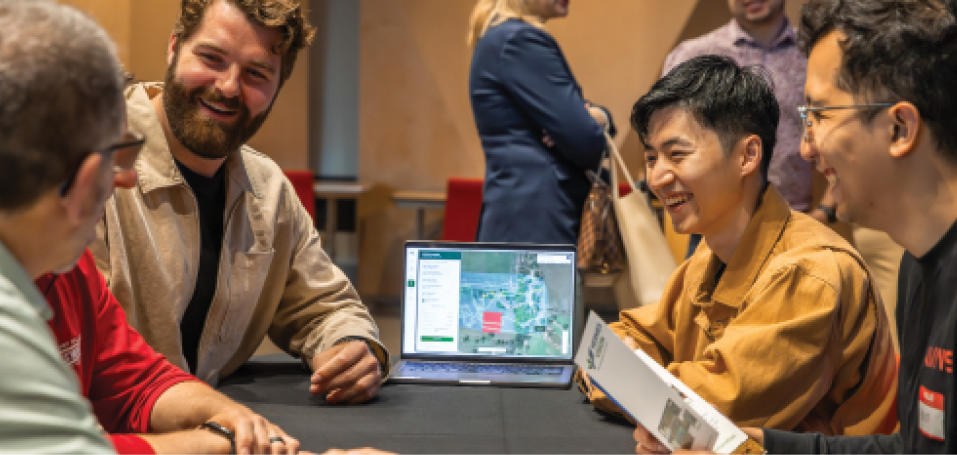
Building at the Speed of AI
Student Entrepreneurship Accelerates Through AI//VS Incubator Course
NIKI KAPSAMBELIS
In the summer of 2025, on a trip home to his family’s ranch in central Texas, Grant Wilkinson watched his mother tackling a problem that has been around since the first cows grazed those plains: fighting invasive plant species.
Having grown up helping on his family’s ranch, Wilkinson was intimately familiar with the problem. Invasive species and weeds reduce the edible vegetation that animals can eat. Some are actually toxic to the animals or consume scarce water supplies. But current commercial weed management solutions spray pesticides broadly across the land, which can be harmful to humans, animals and beneficial plant species.
As his mother prepared to head out into the sweltering Texas heat armed with a backpack of weed killer to individually kill invasive plants while sparing her beloved bluebonnets, Wilkinson thought to himself: there has to be a better way.
So he created one, with the help of two fellow Carnegie Mellon students and a healthy dash of artificial intelligence.
Grant and his co-founders, David Seong and Aditya Pratama, were among the cohort enrolled in the AI Venture Studio course (known colloquially as AI//VS) in the spring 2026 semester. Open to any full-time student on campus regardless of major, as well as part-time online hybrid MBA candidates, the nascent entrepreneurs in AI//VS work on ideas ranging from pitching original musical theater concepts and travel planning to healthcare solutions and finding the perfect fit for press-on nail manicures. The one thing they have in common is that artificial intelligence is integral to their business models.
“The number one thing we screen for is intention and commitment,” said Adam Paulisick, Distinguished Service Professor in the School of Computer Science and the architect and lead instructor of the course. Agnostic of industry, “We bet on people who are thinking big.”
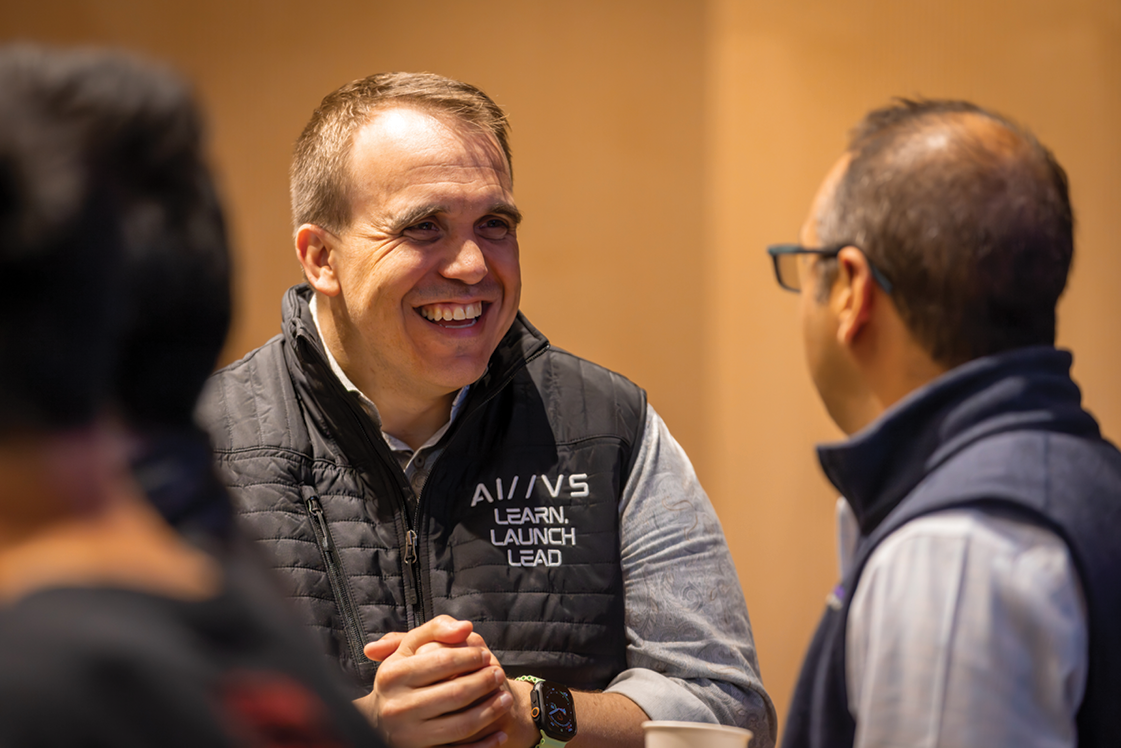
AI//VS architect and senior instructor Adam Paulisick, left, speaks with fellow instructor Sean Ammirati.
Democratizing Innovation
Founded in 2024, AI Venture Studio began with about 50 students, almost all from SCS. But Paulisick — who has taught at Carnegie Mellon for 13 years and holds appointments in the Human-Computer Interaction Institute in SCS and the Tepper School of Business — saw a bigger opportunity to stretch out across campus. With the support of Dave Mawhinney, the founder and former executive director of the Swartz Center for Entrepreneurship, and Michael Shamos, Distinguished Career Professor in SCS and associate director of the MS in Artificial Intelligence and Innovation program in the Language Technologies Institute, Paulisick recruited Sean Ammirati from the Tepper School of Business to join him in teaching the course.
In 2025, AI Venture Studio expanded to include 80 students, and this year it grew to more than 100. Those lucky teams were selected from about 340 applicants, according to Paulisick. Expectations start high, and only rise higher: teams must include three students, two of whom are software engineers, and they must produce a functioning prototype within 10 calendar days of kickoff.
“We’ve broken down all the walls and allowed SCS to bring in the engine to build at the speed of AI,” Paulisick said. “This is an incubator that has a class shape, not a class that has an incubator.”
Ammirati, Distinguished Service Professor of Entrepreneurship at the Tepper School, has been teaching entrepreneurship courses at Carnegie Mellon for about 17 years. He called the AI Venture Studio the manifestation of all previous courses, the one he has always wanted to teach.
During the first year, “the students made incredible progress,” Ammirati said. “That’s primarily because the students are brilliant, but I also think this model of leaning into AI as a co-founder has really helped them make progress quickly.”
Moreover, because the course is open to anyone on campus, students who previously might not have thought of themselves as entrepreneurs now have the opportunity to try out ideas with the help of AI tools that fill in technical gaps.
“It’s kind of a great equalizer,” Ammirati said. “Everybody’s going to need to think about themselves as entrepreneurs going forward. So it’s experiential learning to get them ready.”
When Mawhinney first started companies 35 years ago, it took about two years and $2 million to build a first product for a customer. Today’s founders can complete the same process for pennies on the dollar in a matter of days.
“I think it’s hard for anyone to wrap their head around that time compression and that acceleration,” said Mawhinney. “We’re living in this transformational time. AI is transforming our lives personally, professionally, in our families. We’re making sure Carnegie Mellon entrepreneurs are equipped with the right tools to be at the leading edge of that movement.”
When Faculty Walk the Walk
When Adam Paulisick and Sean Ammirati talk to students in the AI Venture Studio course about the value proposition of using artificial intelligence to found a company, they’re speaking from first-hand experience.
In addition to serving as the course’s senior instructor, Paulisick is also a full-time CEO for skilly, a platform that replaces generic chatbots with governed guide networks built on curated knowledge to answer questions, route people, capture intent and drive next steps. As he teaches entrepreneurship to students, he is also living it alongside them, self-funding skilly to prove how AI can act as a co-founder and make bootstrapping faster, leaner, and more ambitious.
Ammirati took a step back from teaching in 2026 because he was starting a business of his own. The nascent company, Growth Signals, uses generative AI to convert ideas into strategies for corporate teams in a variety of disciplines — research and development, product development, or innovation, as examples.
He continues to teach the AI//VS course along with Paulisick and Mawhinney, though on a more sporadic schedule as his time permits. Mawhinney, who initially served as the course’s executive sponsor, joined the faculty in 2026. However, when Ammirati does speak to the students about the process of building a company with AI baked into the foundation, he’s also walking the walk with them.
“When I’m talking to them about the things they’re experiencing, I can also talk about how I just experienced that,” he said.
For example, Ammirati noticed that some students get nervous about pitching their ideas to investors. “It’s really useful to say, ‘Let me tell you what my experience raising money was like — this is what you should do,’” he said. “And then, obviously, a lot of the first principles of what we’re teaching with AI as a co-founder are deeply integrated into the software that I’m building as well.”
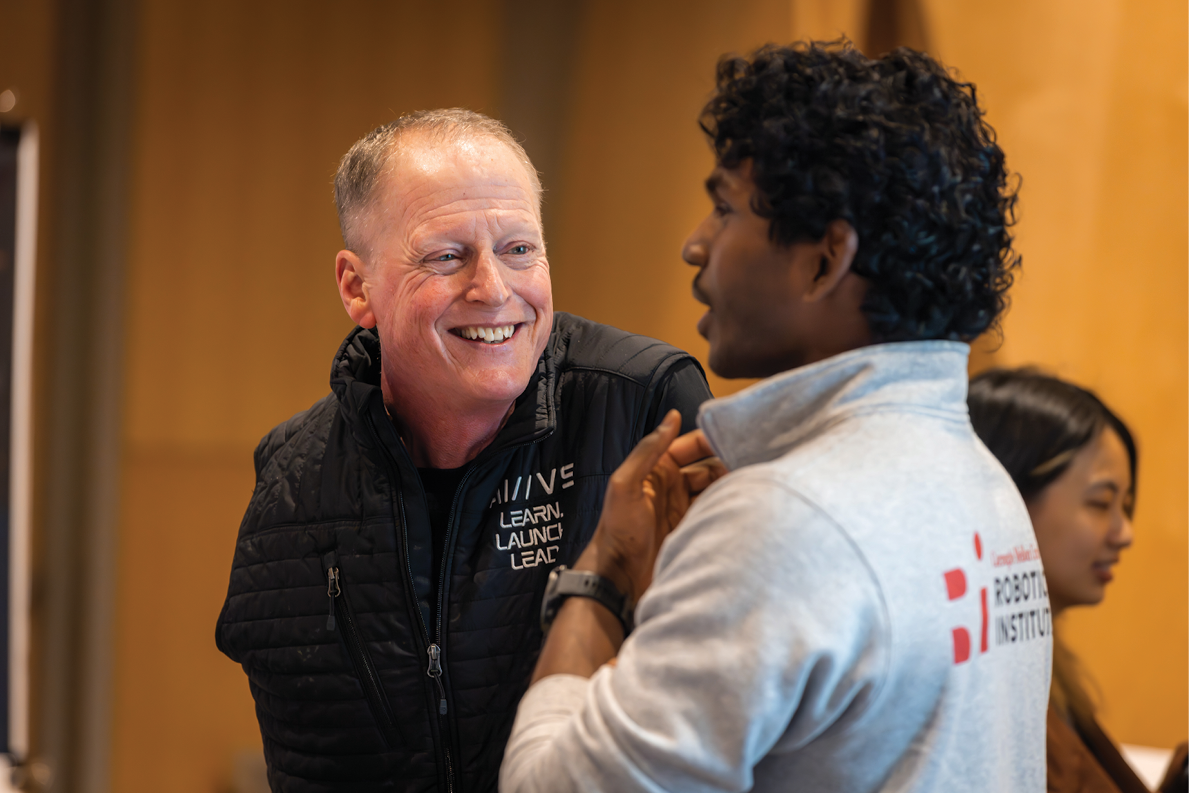
Dave Mawhinney shares a moment of advice with an early career founder.
Honoring CMU’s Heritage
Like the products it helps to create, AI seems to have materialized into the national psyche almost overnight. But at Carnegie Mellon, the marriage of artificial intelligence and business acumen has been a 70-year journey.
The term “artificial intelligence” was coined in the 1950s by a small group that included Herbert Simon and Allen Newell, who were instrumental in creating Carnegie Mellon’s first computer science degree program in 1961, followed by the Computer Science Department in 1965. A decade later, their work would earn them the coveted A.M. Turing Award, often considered the Nobel Prize of computing.
In addition to their work establishing what later became the School of Computer Science, Simon helped form what is now the Tepper School, while Newell earned a doctorate in Industrial Administration from the Carnegie Institute of Technology and later became a member of the faculty.
“We’ve come full circle,” said Mawhinney. “That’s what AI Venture Studio is doing; we serve the whole campus.”
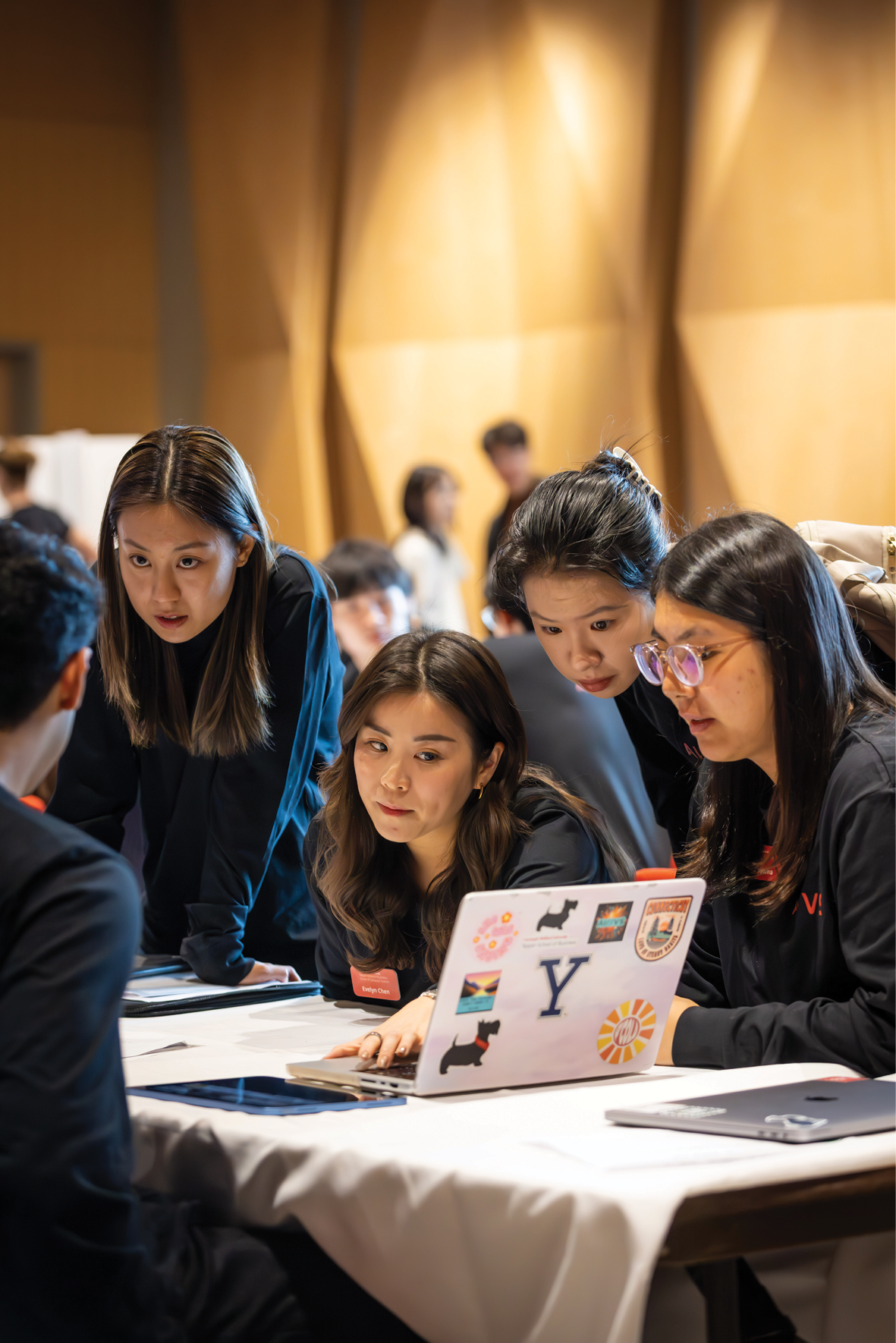
The RoomMuse team presents its B2B augmented reality plugin, which lets furniture brands offer “view-in-room” experiences and analyze customer placement and engagement data, during one of 250+ live investor meetings.
Like the entrepreneurial ecosystem in which it functions, the course also sometimes connects students to people with real-world problems that they hope to solve. Highmark, Covestro and other large enterprises collaborate with the course and help inspire ideas, because they recognize not all problems have an in-house solution, Paulisick noted.
Pranavi Rohit, Raveena Gupta and Cady He met an investor who wanted to remove bottlenecks in the early stage venture capital industry so it could fund the most promising startups. Together, they applied AI to help predict which founders had the most potential for success while also consolidating information for reports, a task that had been manual.
The three students are now partnering with the investor in their company, Quiet Intelligence, which provides a platform benefiting startups — giving them the opportunity to explain metrics and thought processes, providing valuable context — as well as investors. Already, they have pilot customers and are in conversation with others.
“As a team, we’ve moved relatively fast this semester,” said He, a first-year master’s student studying artificial intelligence and innovation in SCS. She hopes to continue building Quiet Intelligence after graduation.
In a letter the three women authored for the Foundry, they spoke about their passion for the startup.
“It’s a disservice to ourselves and the world we want to build if we don’t step out of our comfort zones to solve a problem we know is not only important but can transform an industry,” they wrote.
Solving Problems, Raising Capital
This past April, 55 companies related to AI//VS participated in Demo Day, the culmination of all they learned about taking their ideas to market. Founders had the opportunity to pitch their concepts to actual investors who focus on early stage startups. Also attending were an additional 21 CMU-affiliated companies in collaboration with Innovation Works.
Paul Davis, an environmental engineering senior, stood between racks of clothing sold through his company, Thursday Thrift. He founded the company through AI//VS in 2024, won the Swartz Center’s McGinnis Venture Competition in 2025 and has been building ever since.
“AI is a key differentiator for us,” Davis said, noting that it allows sellers to scan their items and create listings in a matter of seconds. “It helps to increase conversion and decrease inefficiencies and pain points. We cut through the noise with AI.”
A fashion-minded thrift enthusiast, Davis came up with the idea for Thursday Thrift after selling some of his surplus items through pop-ups on campus. The company uses AI to help sellers appropriately price clothes, while buyers receive curated suggestions they might not otherwise see.
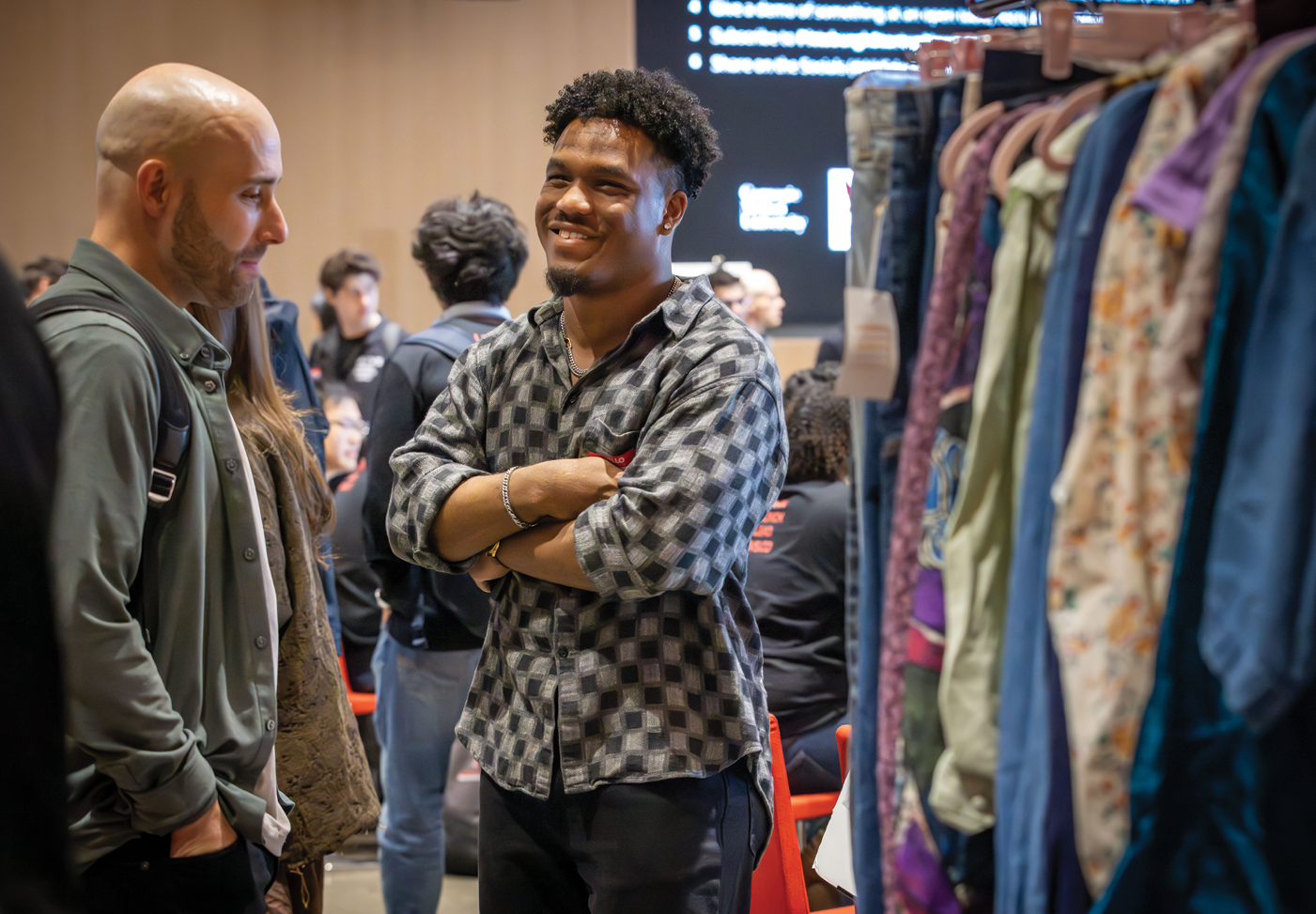
Paul Davis (right) of Thursday Thrift connects with one of 400+ AI//VS Demo Day attendees, who came to learn about the company and shop its live pop-up.
Two decades ago, CMU alumni Susan Gregg Koger (TPR 2006) and Eric Koger (TPR 2007) used a similar idea to found clothing retailer Modcloth, which went on to become one of the university’s great startup success stories. Davis had the opportunity to speak to Modcloth while creating Thursday Thrift. He appreciated how the AI Venture Studio helped him pressure test his concept and offered avenues to explore for investment and advice.
“As an entrepreneur, it’s hard to look at your idea from a different perspective,” Davis said. The course allowed him to think critically, and it also helped him feel less alone.
Wilkinson, the rancher’s son who was looking for a better way to remove invasive species, pitched the company he and his co-founders created, Hermes Vision, which uses a scout drone to identify the location of invasive weeds and capture photos. The company’s system uses the photos to identify exactly where the weeds are and how to treat them, exports the information to a spraying drone, and then deploys it directly to the plant, saving money and using far less herbicide.
Peter Stern, an investor and founding adviser to the Swartz Center, was encouraged by the quality of the ideas he saw presented at Demo Day, as well as the founders’ understanding of their target customers.
In Stern’s view, the AI component is a tool that all entrepreneurs now need, much like earlier startups had to incorporate cloud computing or other technologies as they became available. He noted that he uses AI to research industries prior to meeting with companies.
However, he emphasized that AI cannot replace what makes a good company stand out, which is human ingenuity. “You know what makes them special? That they can build a real, sustainable business, not just a prototype,” he said.
Allison Lechnir, a partner with Hyde Park Venture Partners and early stage investor who also attended Demo Day, agreed.
“My view is that AI, like many things, is a very important tool in a modern founder’s skill set. But to build a company requires humans to imbue the company with their expertise,” she said. “What makes a company defensible can’t just be the AI; it has to be expertise; it has to be data; it has to be a unique distribution model.”
Lechnir said she is consistently impressed with the quality of the founders she meets at CMU.
Granting ‘Functional Superpowers’
Paulisick, Ammirati and Mawhinney expect interest in the AI Venture Studio to continue growing. As Mawhinney noted, some members of the current cohort were already in college when ChatGPT was released, so they have watched AI accelerate in real time.
“There’s an awakening in the next generation to the power of AI,” he said.
Carnegie Mellon has been part of the growing conversation about responsible use of AI, although its growth has happened much faster than the wheels of public policy can realistically turn. It will take time to catch up, Mawhinney said, “but I do believe that we must and we will. We’re in this moment of ambiguity, because it’s coming so fast.”
When the course ends, about one-third of the companies created will end, too. Another third will continue on the traditional venture path, and the remaining third will be part of a new trend of “solopreneurs” who build larger companies with much smaller teams.
“The thing that AI has really unlocked is that you no longer need to overspend and overcommit to a really broad set of stakeholders until you’ve proven value,” said Paulisick. “It’s the fastest we’ve ever given functional superpowers to people
who wouldn’t otherwise have them.”
While not all companies will survive long term, “it’s a good trade for the student either way,” Ammirati said. “If they end up with a successful company, that’s the ideal outcome. But if they don’t, there’s so much more that is valuable to wherever they’re going to go work next. It’s a win-win either way.” ■
More from the Fall 2026 LINK Issue
Where Code Meets Capital