Singing a New Tune: Computational Music
TRICIA MILLER KLAPHEKE
School of Computer Science alumni are developing methods for computers to understand music, while making it easier for any musician, no matter their skill level, to compose it. The field of AI-generated music has come a long way over the last decade, and alumni, such as Sara Adkins, are leading the way.
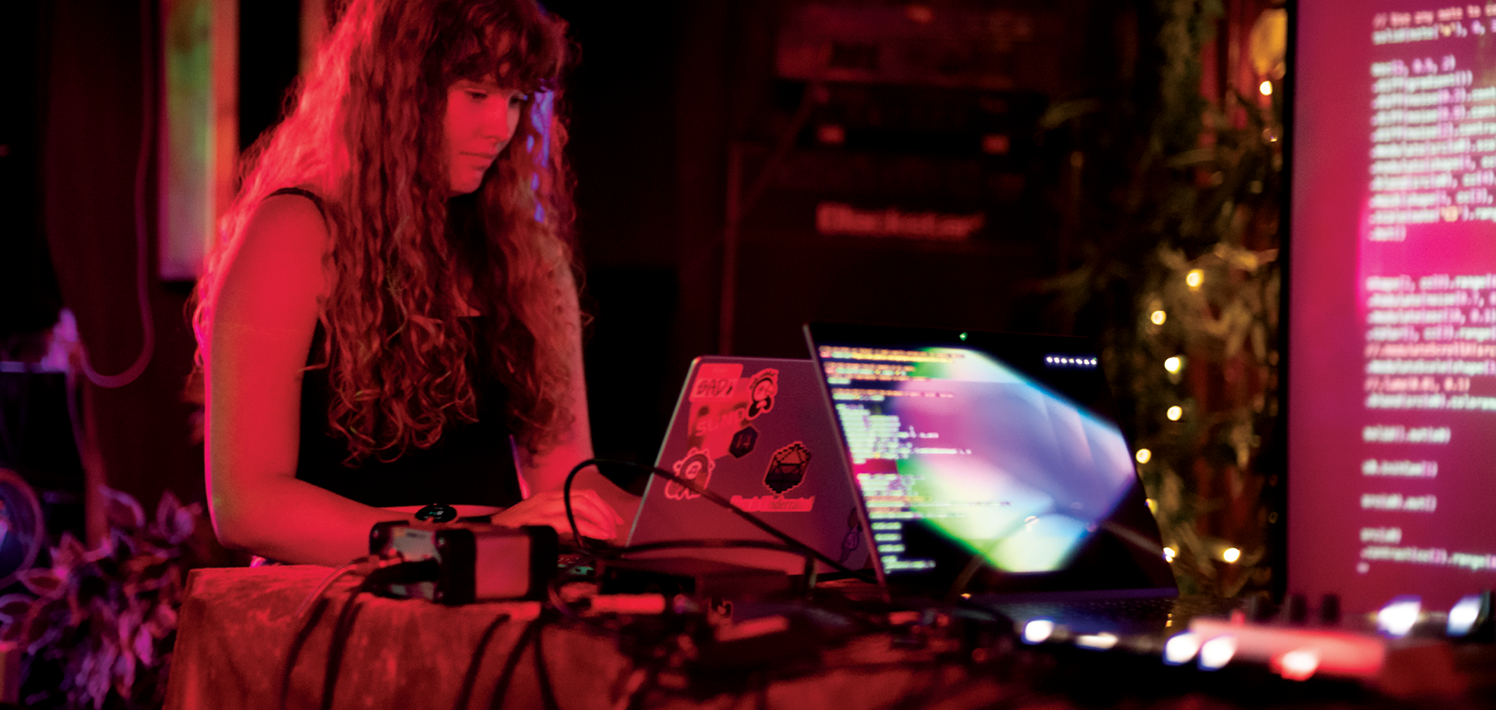
Adkins is the AI music technologist at Suno, one of the premiere companies devoted to using AI for music composition. That title was written for her when she joined the company in the fall of 2024. The majority of her work centers on developing new models with the machine learning team, but a good portion consists of testing the models as an artist to help decide which ones to release to the public.
“I feel like throughout history we keep having more and more ways that make it easier and easier to make music, allowing more people to do it. And I see this as the next iteration of that,” she said of her work at Suno.
Adkins graduated in 2018 from the Bachelor of Computer Science and Arts (BCSA) program, a unique experience for students who excel in both disciplines. Each year, three to five undergraduate students are admitted into SCS and the College of Fine Arts jointly, allowing them to build expertise in both computer science and one of the arts (architecture, art, design, drama or music). To be admitted to the dual program in computer science and music, students must audition and stand out; Adkins auditioned on classical guitar.
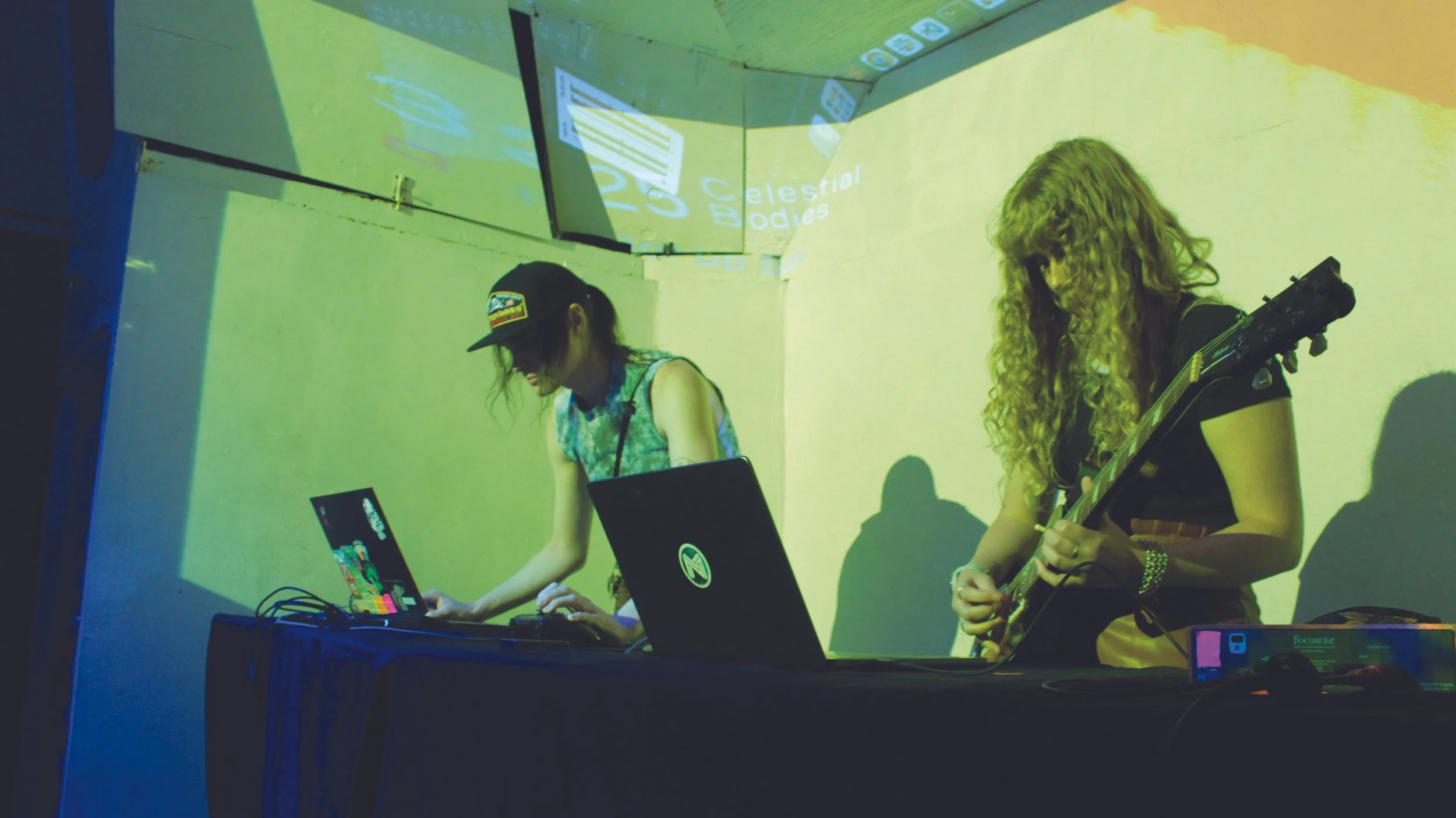
Sara Adkins performs live, combining playing instruments with coding. Click here to see her performances on YouTube.
Adkins went on to win a Fulbright Award, studying computer music and earned her master’s degree in sound and music computing at Queen Mary University of London. In May 2025, she returned to Europe to perform live using Suno outputs and her laptop and guitar on stage in London; Antwerp, Belgium; Barcelona, Spain; and Lyon, France.
“I think the coolest one was the one I did in France,” she recalled. “It was in this huge, abandoned warehouse, and the visuals were set up with what must have been 50 old-school CRT TVs that were displaying the code. It was a 12-hour continuous livestream of rotating performers.”
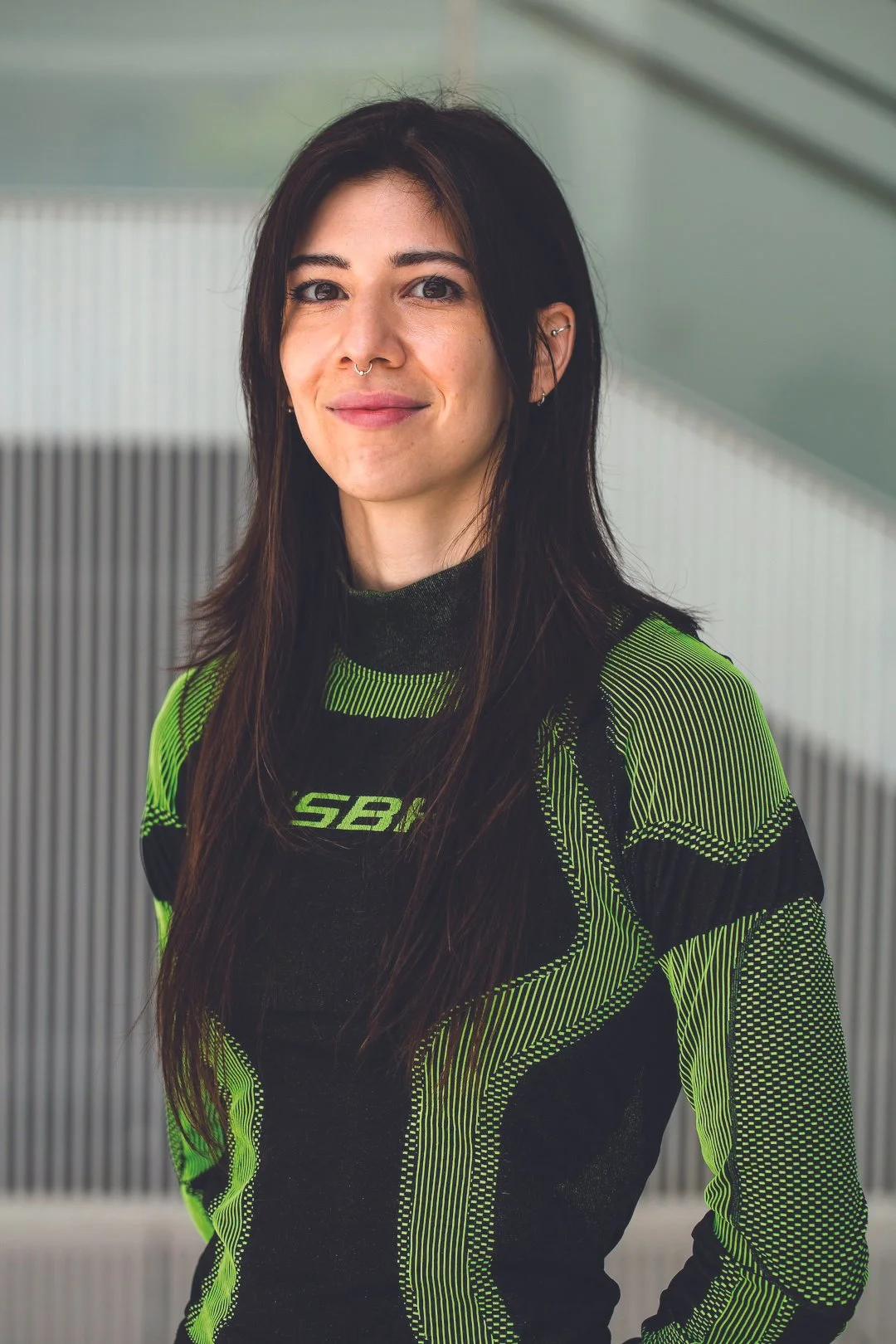
Char Stiles (CMU 2018)
Char Stiles (CMU 2018) has also gone on to be influential in computer music and performance. Stiles also attended the BCSA program but as a student of fine arts. She was admitted as a painting student but says she never painted at Carnegie Mellon, instead using math to make art compositions and 3D graphics.
After graduating in 2018, she worked for a few different startups as a software engineer and eventually went to MIT to explore the future of creative coding while finishing her master’s degree. Now she is making her mark through something she does for fun outside her full-time job as a graphic design engineer: live coding in front of audiences. She describes live coding as being “anti-AI.” While AI might take a lot of human input and produce something average from it, live coding results in the unique product of a human who’s working and making mistakes in real time, Stiles explained.
“In live code, the person is centered and their particularities are really central to the performance,” she said. “You get the sense that coding does have a personal style.”
Connecting The Analytical With The Emotional
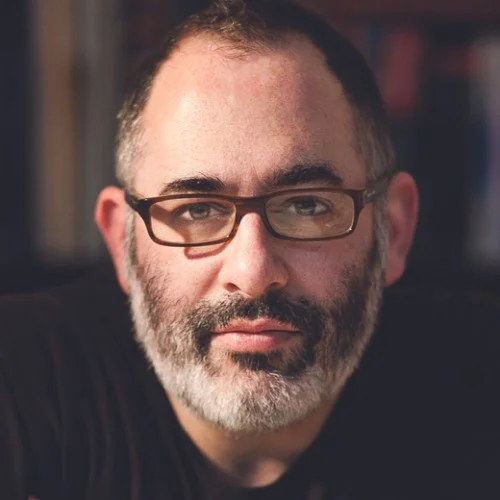
Golan Levin, Professor of Electronic Art
Assistant Professor Chris Donahue teaches Introduction to Computer Music as well as a graduate course on music AI in SCS. Donahue grew up playing piano and drums. When he was nearing the end of his undergraduate degree in computer science, he took an elective class on computer music and was enthralled to find that he could combine his two passions. Donahue is the first to hold the chair endowed by Emeritus Professor Roger B. Dannenberg, who taught at SCS beginning in 1982 after earning his Ph.D. from CMU.
“Roger’s work was enormously influential, both in advancing fundamental computer music research and practice, and in making CMU a leader in the area,” Donahue said. “CMU’s Computer Science Department (CSD) is one of the only U.S. computer science departments that considers computer music a legitimate CS discipline, and that is largely because of the strength of Roger’s research career. I continue to benefit tremendously from his legacy.”
Professor of Electronic Art Golan Levin believes the intersection between computer science and the arts is easier to understand now that game design and Hollywood movies, as examples, are entirely digital. However, he emphasized, this wasn’t the case when he helped create the BCSA program. One of his career goals has been to create a context where students can study across traditional silos.
“One of the things I’m proudest of having done at CMU is help co-create the Bachelor of Computer Science and Arts degree in 2008,” he said. “I genuinely think that we’re producing some of the world’s finest undergrads at the intersection of art and technology, and we don’t produce very many. It’s a unique and rare student who’s able to meet the selection criteria for a program like that.”
“We need to build AI tools that offer real value to musicians and creators.
— Chris Donahue, Dannenberg Assistant Professor of Computer Science in CSD
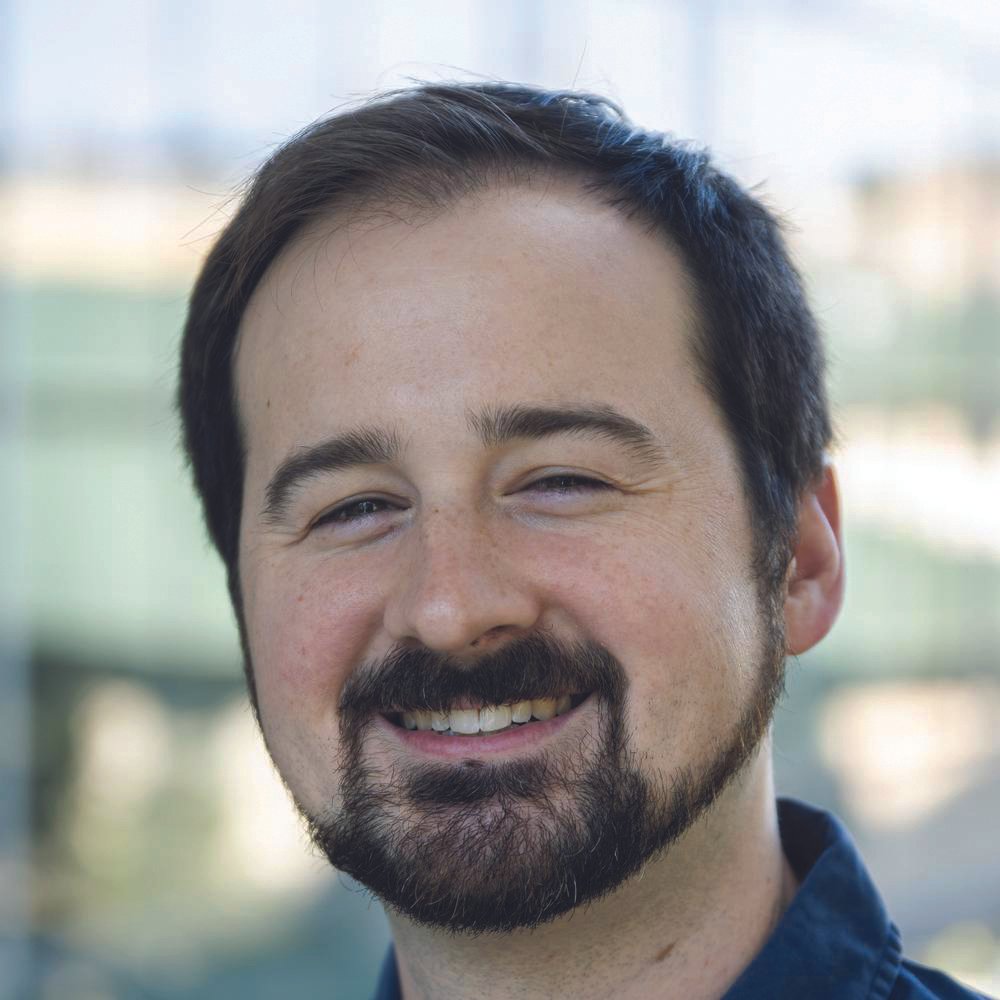
Donahue joined the SCS faculty in 2023 and has three goals for his work at Carnegie Mellon: to help build tools that expand what’s possible in music; to help address the ethical issues raised when AI competes with music rights holders; and to elevate audio signal processing and computer music to be a foundational skill that all computer science students learn, similar to computer graphics.
Donahue’s research group, the Generative Creativity Lab (G-CLef), works to address the ethical questions raised when AI is used to create new music. Donahue believes that at this point, much of AI’s impact on musicians has been negative. But he sees “potential to course correct” in three ways.
“Firstly, as AI starts to compete with musicians, we need remuneration strategies that compensate music rights holders for the value that their data creates within AI systems,” he said. “Secondly, we need to build AI tools that offer real value to musicians and creators. We recently deployed a Copilot-like tool for musicians called Hookpad Aria that has been getting some great feedback. Most broadly, to confront the increasing impact of AI on music, I believe we as researchers should be striving for a more holistic view of research, encompassing not only core AI methods but also broader human-computer interaction and societal questions.”
Democratizing Music Composition At Home, In The Studio And On The Stage
There are two forms of AI music models. The first, more traditional model is symbolic, where the musician tells the model which instruments play specific notes at particular times. It requires more expertise and planning, so it can be more tedious. It tends to be a better fit for experienced musicians.
The second, newer audio models generate sound waves and moods so the resulting compositions can sound more natural and are easier for novices to produce. The drawback is that they can be harder to edit. Suno and Music Control Net, a project Shih-Lun Wu (SCS 2024) worked on with Donahue while getting his master’s degree from the Language Technologies Institute (LTI), fall into the latter category.

Shih-Lun Wu (SCS 2024)
Wu grew up attending a music school in Taiwan, where he learned to play piano and viola and was well-versed in music theory, composition and ear training. He completed an undergraduate degree in computer science in Taipei before coming to Pittsburgh to earn his master’s from the LTI. He is now working toward his Ph.D. at MIT, looking for ways to unify the two families of music models and make them easier for musicians to use. Wu is interviewing musicians about their experiences using AI music applications, exploring ways to bridge the two models. He hopes to eventually develop a model that supports all the operations in the Digital Audio Workstation software that producers use.
“Although these are different representations of music, clearly as musicians there’s a latent understanding behind these two modalities,” he said. “Whether you see the notes, the scores or hear the audio wave forms, your understanding of the music is kind of shared in between them.”
Meanwhile, Stiles’ live-coding session take the opposite approach. Instead of relying on a model to compose music, she writes code to provide an audio and visual experience for concertgoers.
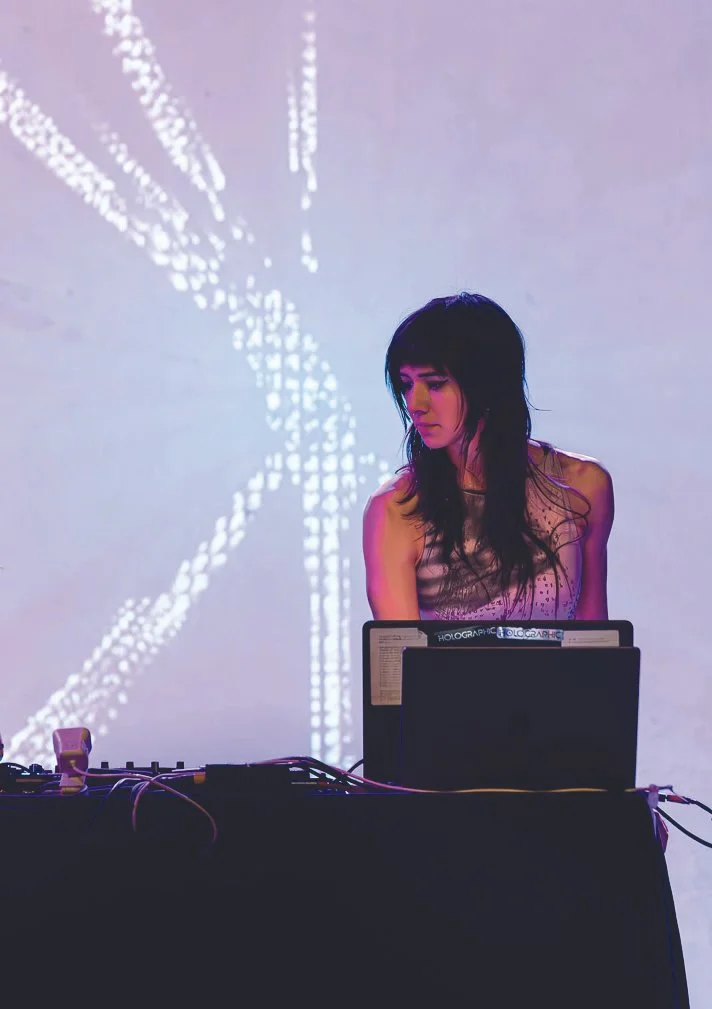
“When I’m coding live, I’m usually coding in places where people aren’t expecting for there to be code, like festivals and clubs.”
— Char Stiles (CMU 2018)
“When I’m coding live, I’m usually coding in places where people aren’t expecting there to be code, like festivals and clubs. People just want to come to dance and see visuals for an hour or two,” Stiles said. “I don’t think it’s fair to expect them to enjoy looking at linear algebra and learning about the Pythagorean theorem.”
Yet Stiles has become popular enough as a performer to attract fans herself. She started learning how to sing and play music in the last few years, then developed skills as a DJ, and finally, while she was finishing her master’s degree at MIT, started performing live coding. In 2025, following advice from an art professor who encouraged students to make sketches and post them publicly, she began doing just that with her live coding experiments. One of her compositions caught on, and her musician friends asked to build on what she had created.
In her academic and professional work, Stiles has spent a lot of time thinking about the future of creative coding, a pursuit for coders who don’t want AI to write code for them but who are so fluent in code that they can use it as a tool the way an artist uses a paintbrush. That’s something she’s doing with both visuals and music as a live coder.
“I’m really lucky to be in a place where this is appreciated,” she said. ■
More from the Spring 2026 LINK Issue

Bringing Computational Sciences to Health and Human Services