Game Changers: How CMU Computer Scientists are Reshaping Professional Sports
SHERI HALL
When Shivaas Gulati (SCS 2010) looks at a professional sports franchise, he doesn’t just see athletes and game strategies — he sees a complex system of interconnected elements reacting and interacting with one another. As the founder of Arkero, a company that brings artificial intelligence to sports businesses, Gulati employs the strategies he learned at Carnegie Mellon and as a successful entrepreneur to transform how teams operate on and off the field. Arkero’s platform optimizes the complex elements of modern sports enterprise — cross-functional project management for gamedays, dynamic actionable insights, fan engagement and operational efficiency. Essentially, Gulati applies computational thinking to build sustainable, efficient sports businesses.
Gulati’s work exemplifies a broader trend among Carnegie Mellon alumni, who are reshaping professional sports organizations across the globe. They’re building platforms that help teams evaluate players, manage complex salary caps, connect season ticket holders with premium opportunities and enhance the stadium experience. Teams once operated more like small businesses and analytics departments focused narrowly on player performance. But today’s sports organizations are discovering that computational approaches apply in all aspects of professional sports.
The migration of computer scientists like Gulati into sports represents a fundamental shift in how modern organizations compete in an entertainment economy worth hundreds of billions of dollars. Teams are striving to dominate on the field while managing real estate, media rights, fan communities and brand partnerships. The shift goes beyond simply collecting information. Now computer scientists are building systems that can convert data into actionable recommendations and improved fan experiences.
Gulati is one of dozens of SCS alumni working with professional sports organizations. Adam Brodie (SCS 2016) — assistant director of research for the Houston Astros — focuses on translating data about player performance into usable information the Astros can employ at a moment’s notice to develop players, select equipment, change strategy during a game and more. Doug Fearing (SCS 1999) serves as chief data officer for Teamworks, which provides technology solutions to more than 7,000 sports teams and military organizations worldwide to optimize talent acquisition, operations and performance development.
Other SCS faculty and researchers have changed the viewing experience for fans. For example, Takeo Kanade, the U. A. and Helen Whitaker University Professor of Computer Science and Robotics, created Eye Vision for Super Bowl XXXVI in 2001. The technology synthesizes video from 30 robotic cameras into a smooth, flowing image that rotates the angle of the view of the play. And Priya Narasimhan, a professor in the Department of Electrical and Computer Engineering, launched YinzCam, an app that allows in-person fans to access video from stadium cameras on their smartphones for better in-game experiences and a closer look at the action, even from the nosebleed seats.
Across the board, the out-of-the-box thinking and complex analytical skills taught at SCS have helped launch careers in professional sports.
“Carnegie Mellon exposed me to a wide range of disciplines and, more importantly, to sharp, like-minded people — both within my program and across campus,” Gulati said. “From SCS, the biggest lessons were grit and tenacity. The late nights grinding through assignments, pushing through complexity and constantly stretching beyond my comfort zone built a resilience that has stayed with me. That mindset — never giving up and being willing to grind through the hard parts — has been foundational in building ‘Zero to One’ companies ever since.”
By using the term “Zero to One,” Gulati is referring to the influential 2014 book by the entrepreneurs and investors Peter Thiel and Blake Masters about building innovative companies.
Helping sports teams catch the “AI wave”
For Gulati, the business of sports is a second career of sorts. After graduating from SCS with a master’s degree in information technology in 2010, he co-founded Remitly, a digital remittance service. In 2021, the company went public through an initial public offering (IPO) valued at $8 billion, the biggest consumer IPO in the Seattle area since Amazon went public in 1997.
Gulati always thought of himself as an entrepreneur. After successfully launching Remitly, he decided he wanted to explore the intersection of his work and a lifelong passion — soccer. “I see sports as a platform to create impact in people, communities and geographic regions,” he said. “The power of sports — big or small — is massive and compounds over time. Currently, there’s not a lot of technology application in the business side of sport, which creates an opportunity.”
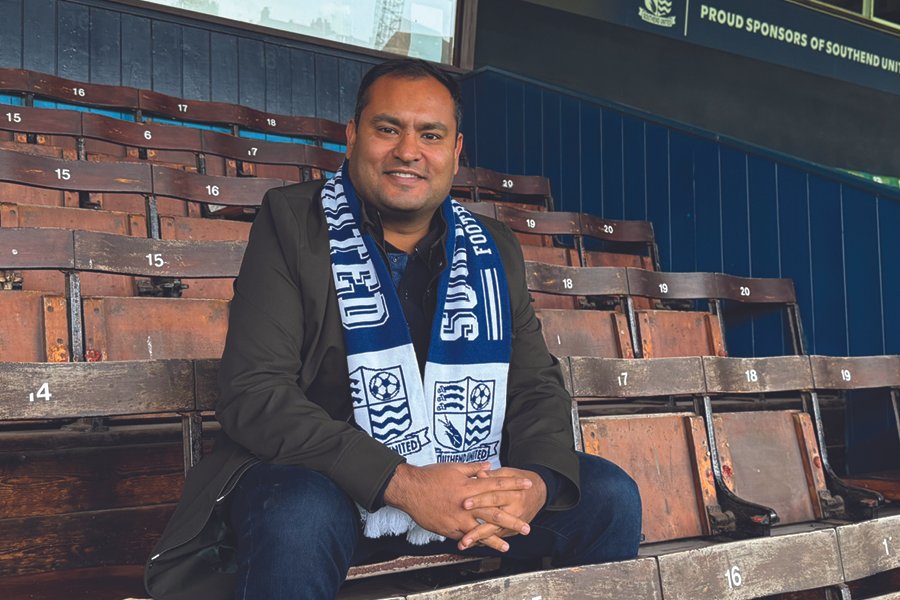
After launching Remitly and investing in other tech companies, Gulati decided the best way to break into professional sports management was to buy into a team. So in 2024, he partnered with a group of investors to purchase Southend United Football Club, a professional team in Southend-on-Sea, Essex, England, that competes in the English National League.
“The purpose of buying a team was to understand the business problems from the inside and do something impactful,” he said. “It’s an amazing front row seat to understanding how dysfunctional soccer clubs are, but also their impacts on people, communities and families.”
So far, Gulati and his team of investors have used AI tools to better understand player contracts and provide performance data to the coaching staff. They’ve moved to a cashless point-of-sales system in the stadium, which speeds up the concession lines. And they are moving toward using AI to improve operational efficiency across their business teams.
“We are solving things slowly,” he explained. “It’s a multiyear strategy to create a sustainable club that is underpinned with technology at the core of our business.”
For Gulati, Southend United FC provided a broader understanding of the sports industry. Last year, he began advising the Seattle Sounders Football Club on their AI and tech strategy, getting a first-hand look at one of the country’s top sports franchises. That work led him to launch Arkero in October. In January, Arkero announced it had raised more than $6 million in a preseed funding round led by Roger Ehrenberg’s Game Changers Ventures, along with four other venture capital firms. Adrian Hanauer, owner of the Seattle Sounders and Seattle Reign football clubs, also invested.
“The software industry is going through a sea change, and industries like sports are behind the curve,” he said. “Many of these businesses are still running on email and spreadsheets, just like 15 years ago. Strategies are still being discussed on white boards in conference rooms without being quantified and recorded. Now every sports owner is saying, ‘How do we make sure we don’t miss the AI wave?’ To me, that’s a massive opportunity to build something specific to this industry.”
Arkero’s core premise is two-fold: helping sports teams build a cohesive operational plan that incorporates business strategy and using data collection and AI analysis to improve fan engagement, retention and revenue.
“How do we make these teams data rich and insight rich, with plans that they can actually implement?” Gulati said. “The goal is to build an intelligent system that understands the business and can tell me what actions I should take based on the insights we collect.”
Translating sports data into action
The idea of analyzing data to help players, coaches and managers make real-time decisions sits at the frontier of sports analytics, explained Adam Brodie, assistant director of research for the Houston Astros. “When you distill it down, we want to understand and predict why certain phenomena exist, and then we want to use that information to make decisions,” he said.
For Brodie, those decisions are broadly focused on the game: How do the Astros select players, adapt their strategy during a game, select the best equipment for each player and decide what players need to work on at practice? A recent focus has been creating web applications for communicating and distributing their insights to players and coaches on a daily basis.
A big piece of the puzzle comes down to which questions the data scientists decide to ask. “I consider myself a baseball scientist,” Brodie said. “I am focused on the language and measures we use. I’m trying to better understand if this is really the best way to evaluate a player. Or is there an advantage to changing the information we use to emphasize things that are more relevant?”
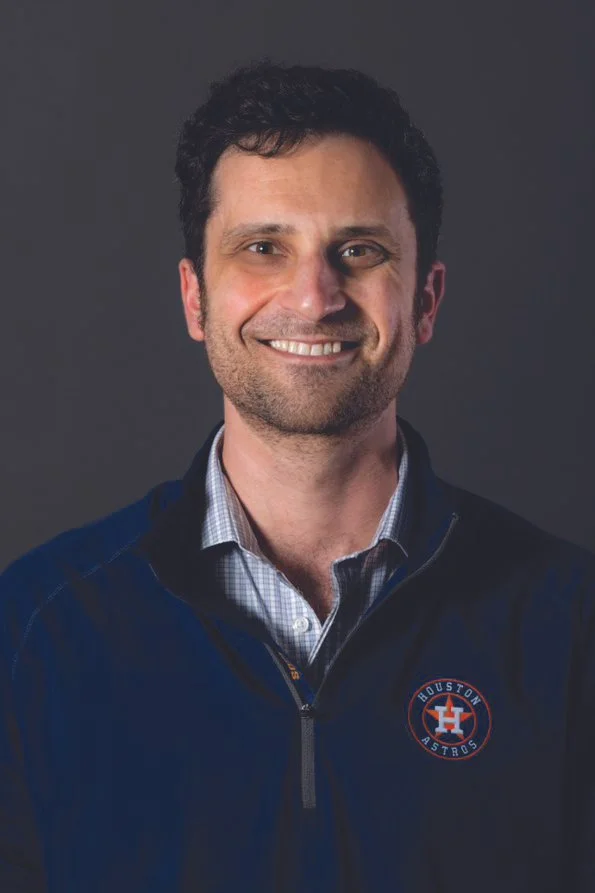
Adam Brodie (SCS 2016), Assistant
Director of Research for the Houston Astros
In nine years with the Astros, Brodie has seen exponential growth in the research department. “The tasks have become more sophisticated,” he said. “We’re adopting practices that are more like a tech company rather than a mom-and-pop operation.”
Brodie’s penchant for deep thinking comes from his first academic love: philosophy. He received a doctoral degree in logic, computation and methodology from CMU in 2017. “The Philosophy Department is untraditional because it emphasizes the foundations of mathematics, computer science and decision theory,” he explained.
Midway through his philosophy studies, Brodie decided he needed to find a way to apply what he was learning to an industry. So he simultaneously began working on a master’s degree in machine learning from SCS. There, one of his projects focused on baseball — specifically how the strike zone was changing in Major League Baseball, and what that meant for strikeout rates. From then on he was hooked. “I felt like we really learned something that would be useful to teams,” he said. “It’s to the credit of my advisors, Peter Spirtes and Sam Ventura, who were willing to help me.”
Today, Brodie uses much of what he learned at Carnegie Mellon on the job. “As my role has developed, I’ve learned to appreciate and apply more of the principles from my time at graduate school in both philosophy and machine learning,” he said. “The question is really, what do you want to model and how do you want to evaluate it? Reflecting on the things I learned in school gives me the breadth to understand there’s all sorts of resources out there.”
“Solving challenging problems with talented people”
Similar to Gulati and Brodie, Doug Fearing (SCS 1999) never expected to find himself working in sports analytics. After graduating from SCS, he spent five years at Trilogy Software. When he paused work to care for his newborn son, Fearing got into fantasy baseball and learned he had a talent for analyzing sports metrics. The hobby sparked the idea for a new career path, and Fearing enrolled in a sports management seminar while completing his Ph.D. at MIT.

Doug Fearing (SCS 1999), Chief Data Officer for Teamworks
Fast forward 10 years: the Los Angeles Dodgers hired Fearing to build its research and development department. (You can read about Fearing’s tenure with the Dodgers in the Summer 2018 issue of The LINK magazine.) From there, he teamed up with colleagues from Harvard to launch Zelus Analytics, a company focused on using player tracking data to support decision-making in professional sports.
Zelus offered analytic platforms focused on game play with the ultimate goal of influencing strategies, recruiting decisions and priorities at practice. “Seeing how players move in the field helps you better understand how they’ll perform,” Fearing said. “Once you understand the characteristics of their performance, you can deploy them better. For example, if you know that a certain kind of hitter is better against a certain kind of pitcher, you can more effectively deploy those players in games.”
Zelus began in professional baseball, but quickly expanded to soccer, basketball, football and ice hockey. The company uses player tracking data collected from video technology and wearable sensors and employs proprietary algorithms to analyze that data.
In 2024, Zelus was acquired by Teamworks, a sports management platform that offers data-driven products for talent acquisition, operations and performance development to professional and NCAA teams. As the chief data officer at Teamworks, Fearing runs their data science research group.
Across a broader range of teams and sports, Fearing still has the same goals as when he began in sports analytics. “How do you acquire the best players and build the best team, and then how do you deploy those players, understand their strengths and weaknesses, and their opponents’ strengths and weaknesses?” he said.
Answering these questions comes back to a core value that he developed as an undergraduate at SCS. “CMU really instilled in me a passion for solving challenging problems with talented people,” he said. “That’s been the through line of my career, starting with developing software in 1999 to working with Teamworks today.” ■
Perflection AI: Taking a Swing at the Perfect AI Coach
Athletics have helped Zack Li (ENG 2022, SCS 2024) through the most difficult periods in his life. From his days as a high school athlete to being the young entrepreneur he is today, Li has participated in a myriad of sports including badminton, snowboarding, ice hockey, tennis and golf.
“My own sports have been the north star of my life,” he said. “Breaking physical limits and the spirituality of athletics have helped me grow, preserve and build mental muscles. I want more people to experience the same journey that I have with sports. To do this, good guidance is important. But I realized there are a limited number of coaches and not everyone has access to coaching resources.”
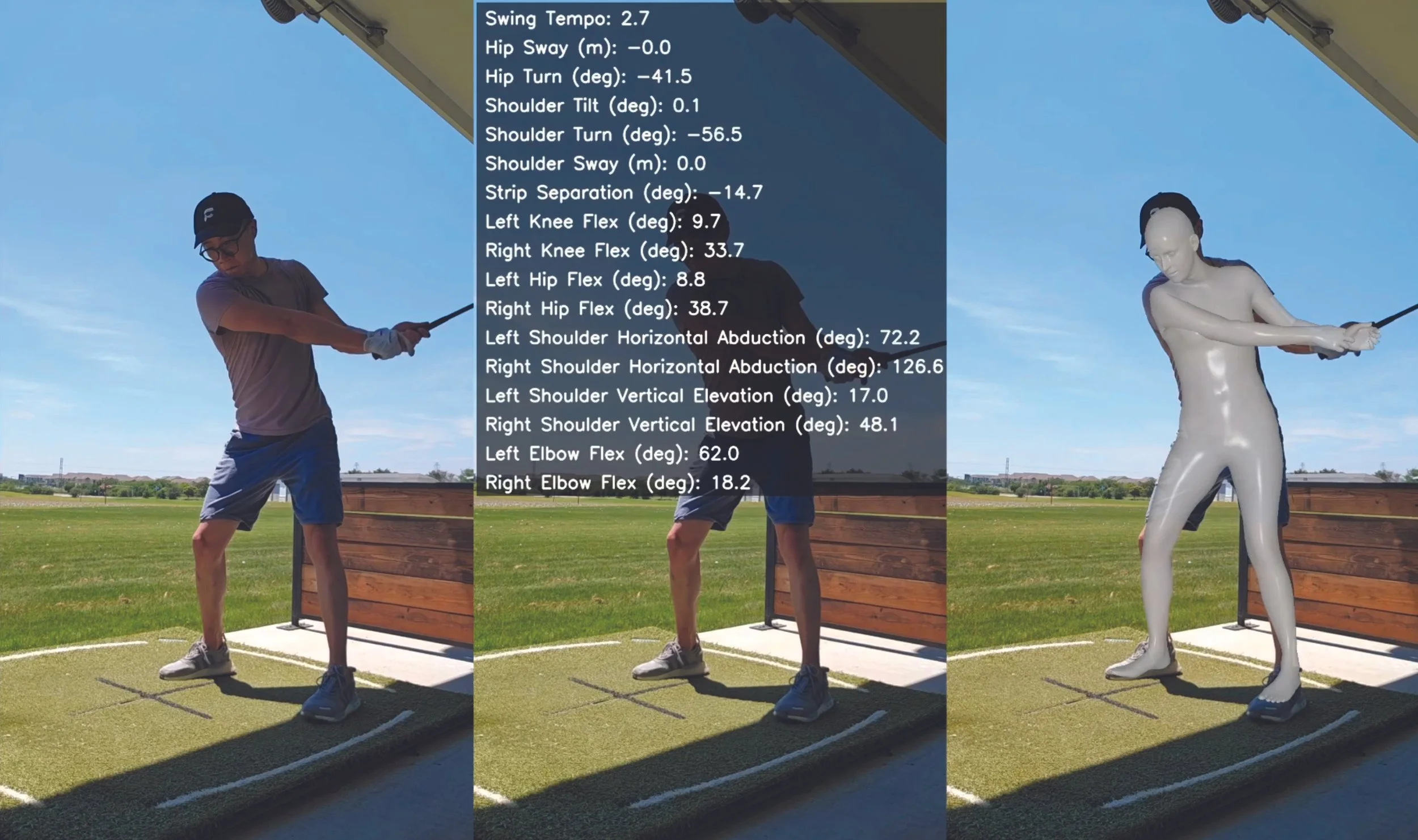
A screen capture of Perflection AI analyzing a golf swing.
This realization led Li to combine his two passions — sports and technology — to start Perflection AI, a sports technology company that provides accessible and individualized instructions via “digital twins” of human coaches. The company recently launched its AI-based golf coaching platform in the U.S. and plans to expand to other sports.
“Sports are an extreme form of expressing yourself,” Li said. “Starting a business is also a form of expressing myself — maybe it’s the ultimate one. This company reflects my values.”
Li developed the idea for Perflection AI during informal networking sessions with a fellow graduate student at CMU, Yuhao Gary Liu (ENG 2022, TPR 2022). “A few guys got together every week to talk about fun new ideas,” he said. “We decided to vote on which idea we would want to turn into a business.”
With the help of his advisor Ron Yurko, the director of the Carnegie Mellon Sports Analytics Center (CMSAC), Perflection AI was a finalist in the 2024 McGinnis Venture Competition, a startup competition run by CMU’s Swartz Center for Entrepreneurship where the winners receive mentorship from alumni and funding for their projects.
Since then, some co-founders have left for other jobs, but Li has stayed on full time.
Li said the company began with golf coaching, in part, because he believes the spirit of the game mirrors starting a business.
“Even the best athletes make mistakes 60% of the time,” he said. “It’s entirely about embracing the uncertainty and working toward the goal of getting the ball in the hole. You can’t think about your past failures or successes; you have to stay in the moment and focus on the goal.”
Li will be raising a round of funding in early 2026 to bring Perflection AI’s full golf training co-pilots to market.
More from the Spring 2026 LINK Issue

Bringing Computational Sciences to Health and Human Services